
8 Simple Self-Care Practices to Support Your Well-Being
Self-care does not have to be complicated.
You do not need a perfect morning routine, an expensive wellness plan, or several uninterrupted hours every day. You do not need to become a different person before you are allowed to feel better.
For professionals, leaders, and growth-oriented adults, the most useful self-care practices are often the ones that can be integrated into real life.
Real life includes meetings, deadlines, family responsibilities, difficult conversations, travel, caregiving, uncertainty, and days when your energy is limited.
The goal is not perfection.
The goal is to develop small practices that help you remain connected to yourself while meeting the demands of your life.
Self-Care Does Not Have to Be Complicated
Many people postpone self-care because they imagine it requires a major lifestyle change.
They think they need to:
- Completely reorganize their schedule
- Take an extended vacation
- Establish an elaborate fitness routine
- Eliminate all stress
- Become more disciplined
- Find the perfect therapeutic approach
But meaningful change often begins with something much smaller.
A boundary. A walk. A meal. A conversation. A moment of reflection. A decision to stop treating exhaustion as a personality trait.
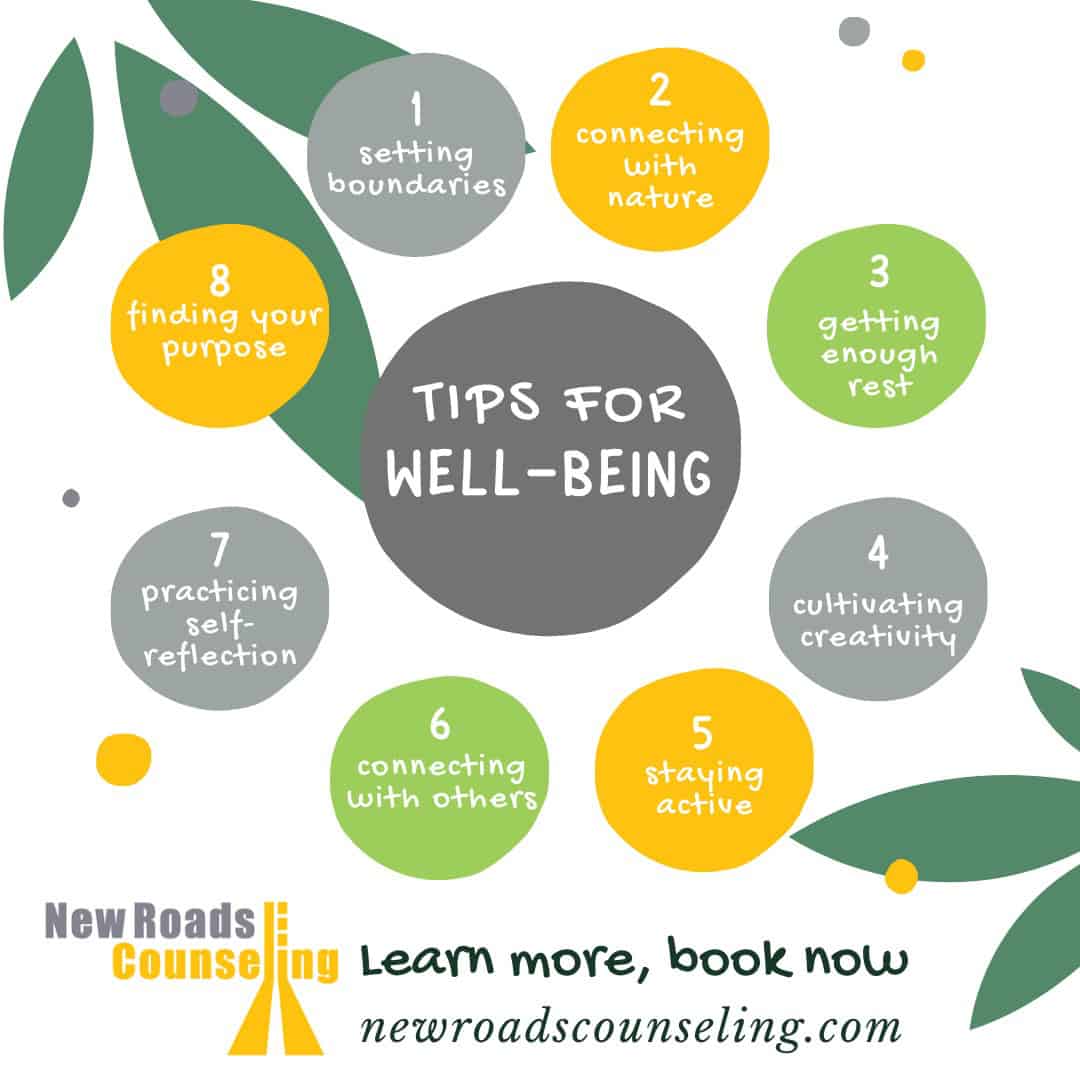
Well-being is supported by small, consistent practices that care for the whole person.
Here are eight practices that can support your mental well-being.
1. Set Healthy Boundaries
Boundaries are one of the most important forms of self-care because they protect your energy and clarify your availability.
You may need boundaries around:
- Work hours
- Email and phone access
- Family obligations
- Emotional conversations
- Social commitments
- Your physical space
- Your willingness to solve other people’s problems
A boundary might be as simple as refusing to check work email during dinner or explaining that you need more notice before accepting a new responsibility.
Healthy boundaries are not about controlling other people. They are about communicating what you will do and what you are able to sustain.
2. Connect With Nature
Time in nature can create a transition between the intensity of your responsibilities and the quieter part of yourself that often gets overlooked.
You might:
- Take a walk before work
- Sit outside without your phone
- Eat lunch in a park
- Spend time gardening
- Notice the trees, sky, or changing light
- Walk near water
- Practice forest bathing or mindful observation
The goal is not to turn every walk into a performance-improvement strategy. Let it be a way to slow down and experience something beyond your own thoughts.
New Roads Counseling’s weekend therapy retreats take place at Wildwood Ranch, a private natural setting in the Sierra foothills of Northern California. The environment includes open space, nature trails, forest bathing, and quiet areas for reflection between therapeutic sessions. (NEWROADSCOUNSELING)
3. Get Enough Rest
Rest is not laziness. It is not something you must earn after completing every task.
Rest may include sleep, but it can also include periods when you are not producing, solving, achieving, or responding.
Ask yourself:
- What kind of rest am I missing?
- Do I need physical rest?
- Do I need mental quiet?
- Do I need time away from decision-making?
- Do I need emotional support?
- Do I need a break from being responsible for everyone else?
A full calendar does not necessarily reflect a meaningful life. Sometimes it reflects a life that has no room to recover.
4. Cultivate Creativity
Creativity gives your mind another way to process experience.
You do not have to consider yourself an artist. Creativity might involve:
- Writing
- Music
- Cooking
- Photography
- Drawing
- Gardening
- Building something
- Rearranging a room
- Dancing
- Reading
- Solving a problem in a new way
For professionals, creative activities can also interrupt the constant emphasis on efficiency. They remind you that not everything valuable has to be measured by productivity.
Creativity can be a way to reconnect with curiosity, play, expression, and identity outside of your professional role.
5. Stay Active
Movement can support your overall well-being without becoming another area where you criticize yourself.
You do not need to follow an extreme plan. Consider:
- A short walk between meetings
- Stretching before bed
- Taking the stairs
- Hiking on the weekend
- Dancing in your kitchen
- Practicing yoga
- Going for a bike ride
- Doing simple strength exercises
The most sustainable movement is usually the kind you can realistically continue.
The goal is not to punish your body or earn rest. It is to stay connected to your body as a living part of your experience.
6. Connect With Others
Independence is valuable, but complete self-sufficiency is exhausting.
Supportive relationships give you opportunities to be known, encouraged, challenged, and comforted. Connection may involve a partner, friend, family member, colleague, mentor, spiritual community, or therapist.
Try making connection more intentional:
- Schedule a meaningful conversation
- Call someone instead of sending a quick message
- Share honestly instead of automatically saying you are fine
- Ask someone how they are really doing
- Spend time with people who allow you to relax
- Notice which relationships leave you feeling supported and which consistently deplete you
You do not need a large social circle. A few emotionally safe relationships can be deeply important.
7. Practice Self-Reflection
Self-reflection helps you notice what is happening beneath your habits and responsibilities.
You might reflect through:
- Journaling
- Mindfulness
- Prayer
- Meditation
- Therapy
- Quiet walks
- Reading
- Talking with a trusted person
Useful questions include:
- What am I feeling?
- What am I avoiding?
- What matters most to me right now?
- Where am I out of alignment with my values?
- What pattern keeps repeating?
- What would I do differently if I trusted myself?
- What support do I need?
Reflection is not the same as overthinking. Overthinking circles the same question without movement. Reflection creates space for awareness, choice, and action.
8. Explore Your Purpose
Purpose does not have to be grand or visible to other people.
It may be found in:
- Caring for your family
- Leading with integrity
- Creating meaningful work
- Serving your community
- Supporting others
- Practicing your faith
- Learning
- Building relationships
- Making something beautiful
- Living according to your values
Sometimes people become disconnected from purpose because their professional identity has become too narrow. They may be successful but no longer feel engaged. They may be accomplishing goals that once mattered but now feel empty.
Exploring purpose does not require an immediate career change. It may begin by asking:
What kind of life am I trying to build, and what would make my daily choices feel more aligned with it?
Begin With One Small Step
You do not need to practice all eight habits immediately.
Choose one.
Take a walk. Protect your evening. Call a trusted person. Eat lunch away from your desk. Spend ten minutes writing. Schedule the consultation you have been postponing.
Then notice what changes.
You may notice more clarity, more energy, greater emotional awareness, or simply a stronger sense that you are participating in your own life.
If you are ready to make meaningful changes but are unsure where to begin, therapy can help you identify your needs, clarify your goals, and develop practical ways to support your mental health. New Roads Counseling works with adults navigating anxiety, depression, trauma, grief, burnout, relationship difficulties, and major life transitions. Learn more about our services
For people who want focused therapeutic work, intensives are available virtually and in person. For those seeking a more immersive experience, private weekend therapy retreats at Wildwood Ranch offer extended therapeutic time, preparation before the retreat, and follow-up support afterward. Learn more about our retreats
Self-care is not about creating a perfect routine.
It is about creating a life in which your mental health has a place.
Choose one practice. Begin where you are. Let small, consistent care become part of the road forward.
Series Navigation
This is part three of our September self-care series.
Begin with A Simple Mental Health Checklist for Practicing Self-Care and continue with Self-Care Includes Boundaries, Support, and Self-Compassion.
Ready to Take the First Step?
If something on this page resonated with you, I’d love to connect. The first step is a free, no-pressure consultation call where we can talk about what you’re navigating and whether working together might be the right fit.
There’s no commitment required. Just a conversation.
Schedule a Free Consultation